
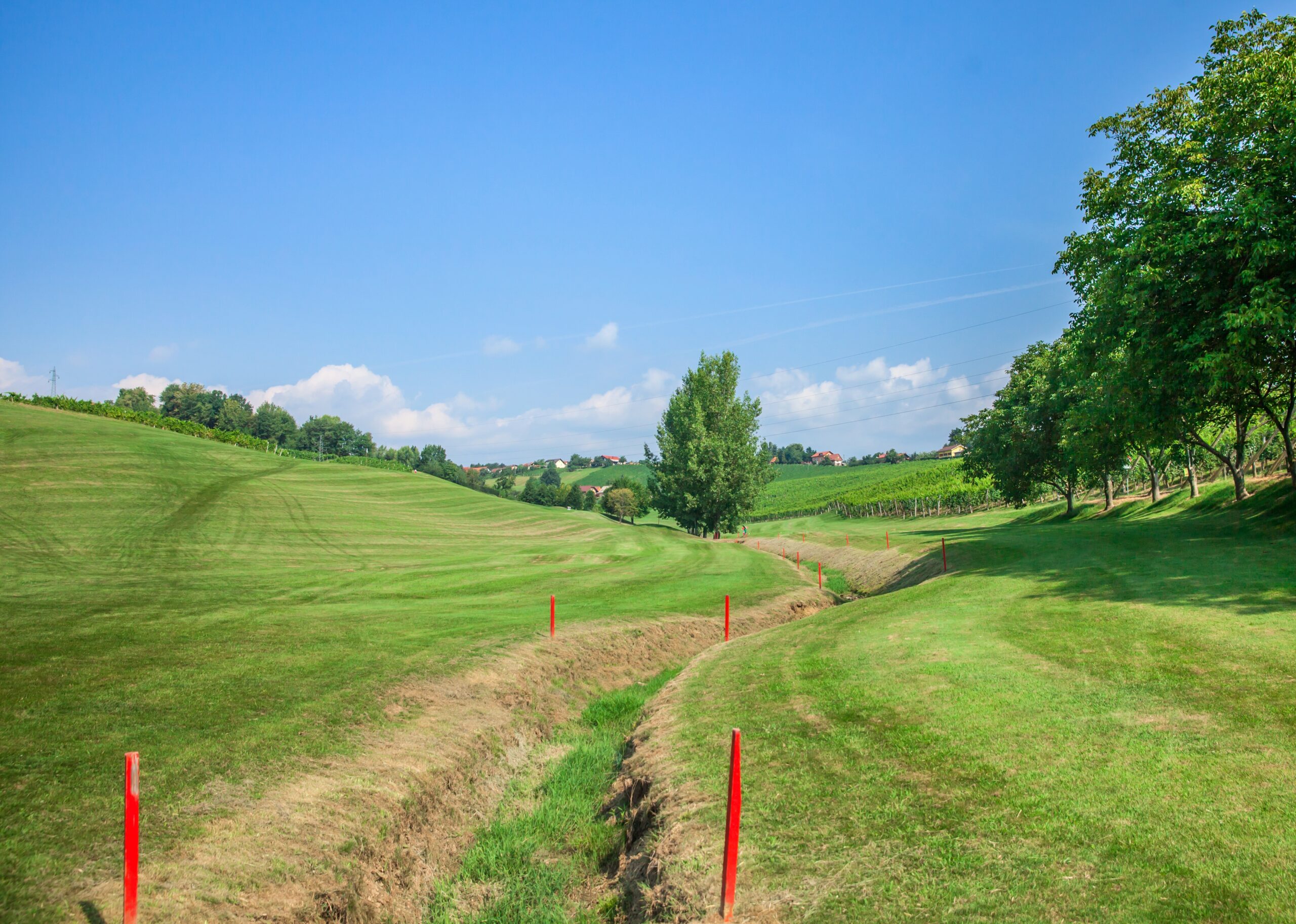
Understanding the Importance of Golf Course Drainage Design
To maintain playability and turf health, while allowing a golf course to sustain long-term viability, the design of golf course drainage systems is fundamental. Golf courses without adequate drainage are subject to turf damage, waterlogging, delayed play, and increased maintenance costs. An effective golf course drainage design utilises engineering, landscape planning, and environmental considerations in conjunction with one another, in order to manage surface and subsurface water efficiently. With today’s emphasis on performance-driven golf and climate-sensitive development, golf course drainage design has become a necessity, rather than a luxury.
How Golf Course Drainage Design Improves Playability and Safety
An intelligently designed golf course drainage system allows golfers to play the course soon after heavy rainfall due to the reduction of puddles, wet areas, or course closures from the excess water. The control and management of excess water from the golf course and integration with golf course irrigation systems through drainage systems enable golfers to experience consistent playing conditions over an entire calendar year.
- Prevent standing water in golf fairways and greens
- Reduce the number of wet or slippery areas that cause player accidents
- Allow for the quick reopening of the golf course after rain
- Give golf players consistent ball roll and firmness of turf
Protecting Turf Health with Effective Golf Course Drainage Solutions
The balanced levels of oxygen and water are critical to healthy turfgrass. Golf course drainage solutions are designed to help remove excess water from the root zone while also providing a means of distributing irrigation water efficiently. This balance helps prevent root rot, fungal diseases, and thinning out of turf, which leads to the growth of healthy and strong grass throughout the entire golf course.
- Improve soil aeration and root development
- Reduce turf diseases that are caused by excess moisture
- Increase nutrient absorption
- Extend the life of the turf and its quality
Integrating Golf Course Drainage Design with Irrigation Systems
Modern golf course drainage design works hand-in-hand with golf course irrigation systems. Coordinated planning ensures water is distributed evenly and removed efficiently, preventing overwatering. This integration optimizes water usage, supports sustainability goals, and reduces operational costs for course managers.
Drainage vs Irrigation Integration
| Aspect | Drainage Design | Irrigation System |
| Purpose | Removes excess water | Supplies controlled water |
| Impact on Turf | Prevents waterlogging | Maintains hydration |
| Sustainability | Reduces runoff | Minimizes water waste |
Environmental Benefits of Proper Golf Course Drainage Design
It reduces sedimentation, soil erosion, and surface run-off into surrounding bodies of water, as well as pollutants from surrounding areas. Stormwater management using environmentally-friendly methods protects ecosystems and adjacent land areas from pollution and helps promote environmentally-responsible practices for constructing golf courses. The following are the benefits of the use of environmentally-friendly stormwater management methods:
- Minimization of soil erosion and sedimentation
- Protection of adjacent bodies of water (e.g., lakes, rivers, and wetlands)
- Support for responsible land use practices
- Compliance with environmental regulations
Reducing Maintenance Costs Through Smart Drainage Planning
Investing in proper golf course drainage design significantly lowers long-term maintenance expenses. Efficient golf course drainage solutions reduce turf replacement, chemical treatments, and labor costs, making course operations more predictable and financially sustainable.
- Lowers turf repair and replacement costs
- Reduces need for chemical treatments
- Minimizes labor-intensive maintenance
- Improves long-term return on investment
Adapting Golf Course Drainage Design to Modern Climate Challenges
With unpredictable weather patterns, modern golf course drainage design must handle intense rainfall and extended wet periods. Advanced golf course drainage solutions improve resilience, ensuring courses remain functional despite climate variability and extreme weather conditions.
- Manages heavy rainfall effectively
- Prevents flood damage to course features
- Supports year-round playability
- Enhances climate resilience
Golf Course Drainage Design Surface Drainage Techniques
Surface drainage techniques are used to help move excess water off the areas of play (tee to green) and are accomplished through the use of slopes, swales and contours on the site. Surface drainage techniques are critical in golf course drainage design to minimize the formation of puddles in the fairway areas, while allowing for the preservation of the natural aesthetics of the golf course by not interfering with the contours of the site.
Subsurface Drainage Systems Provide Long-Term Drainage Performance
Subsurface drainage systems are used to remove the water that collects below the surface of the soil and as such protect the root zone of the turf. Subsurface drainage systems are one of the key components of golf course drainage systems and ensure a uniform and consistent soil environment as well as the stability of the turf on greens and fairways over the long term.
Soil Analysis is an Important Part of Golf Course Drainage Design
The composition of the soil will determine the rate of water movement through the Soil. Therefore, a thorough analysis of the soil is necessary to determine the soil’s permeability, compaction and drainage requirements and allow for the implementation of appropriate and correct drainage solutions.
Technology Improves Golf Course Drainage Solutions
Technology (such as 3D modeling, GIS mapping, and simulation tools) has improved the accuracy of golf course drainage systems by allowing for improved visualization of water movement, as well as the integration of golf course irrigation systems and minimizing errors during construction and maintenance of the golf course drainage systems.
Frequently Asked Questions

Founder & CEO
Bigyan Kar is the driving force behind Geoshot Technologies and has been since its founding, leading the company’s vision in delivering advanced CAD, GIS, graphics, map illustrations, and 3D solutions across multiple industries. While Geoshot serves a wide range of sectors, Bigyan has maintained a strong specialization in golf course graphics.
